Peak Christmas
During recent weeks, there has been a lot of reports, in Sweden and
other countries, about a threatening severe influenza wave. In UK,
media, and even health care officials, have talked about super flu
(NHS England 2025). The reason for that is a fast increase in cases, driven by
a new variant of the A(H3N2) subtype, the so-called subclade K
(Dapat et al. 2025). This subclade has considerable antigenic drift relative to
previously circulating variants of A(H3N2), including the vaccine
component, and this may lead to increased \(\r\) with faster and higher
spread in the general population, as well as decreased vaccine
effectiveness. However, disease severity does not seem to be increased,
and vaccine effectiveness against emergency department attendences and
hospital admission seems to be in the normal range, at least early
post-vaccination (Kirsebom et al. 2025). In England, reported cases have
declined somewhat recently, from a peak lower than the seasons 2022/23
and 2024/25 (UK Health Security Agency 2025).
Clearly, Sweden has not been spared from early rise in influenza. There were reports about large rates of absence in some schools, apparently caused by influenza outbreaks, already around early Advent (Boström 2025). Fig. 1 shows reported non-sentinel influenza A cases in Sweden by week, for influenza seasons (defined by week 40 to week 20) from 2021/22 to the current season, 2025/26, i.e. all seasons since influenza returned after its absence during the covid-19 NPI:s, based on data from WHO (2026).1
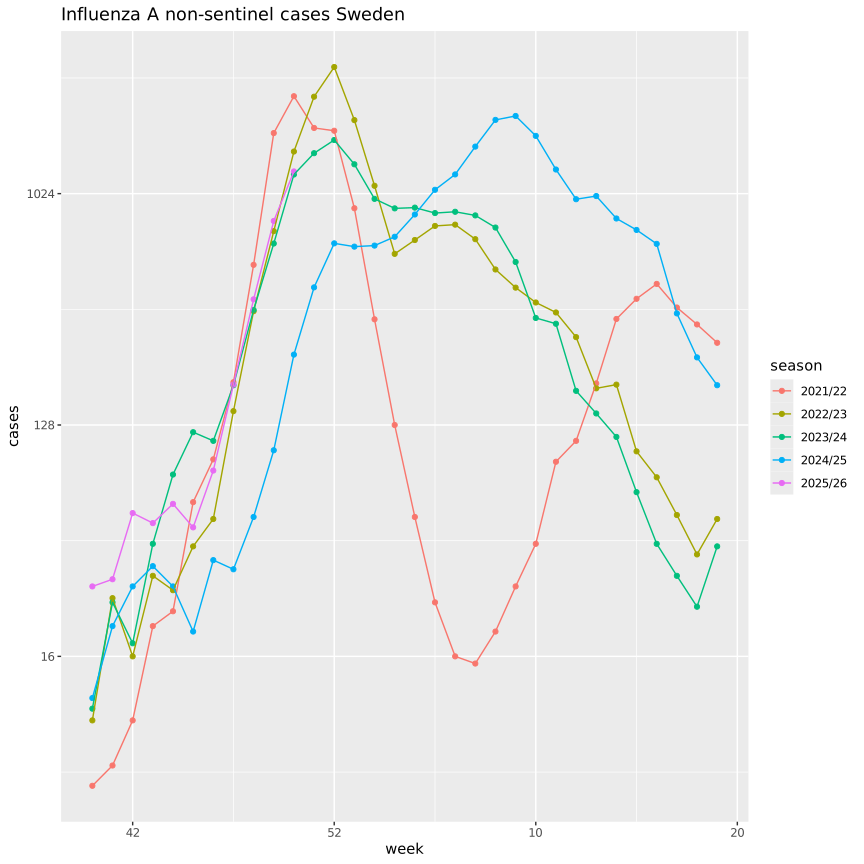
As the figure shows, influenza A cases have increased rapidly recent weeks. One may note that all the finished influenza seasons since 2021/22, except for 2024/25, have peaked around New Year, or somewhat earlier. The 2021/22 season is also probably somewhat inflated relative to the other seasons, due to the higher levels of testing, and the rapid decrease in cases during January 2022 is probably largely because of increased NPI:s due to the first omicron wave. However, 2022/23 and 2023/24 both peaked week 52, which contrasts with the most common pattern before 2020, which was more like 2024/25: exponential increase during November and December, followed by a slowdown over Christmas break, then a slower relative increase, and a February peak.
Early in the current season, most subtyped cases were A(H1N1)pdm09, but since week 47, A(H3N2) has dominated. Among the subtyped cases week 50, reported in the last WHO (2026) update, 256 were A(H3N2), while 83 were A(H1N1)pdm09. The partially interrupted 2021/22 season was also dominated by A(H3N2), while 2022/23 and 2024/25 were mixed A(H3N2) and A(H1N1)pdm09, as well as B/Victoria, and 2023/24 was dominated by A(H1N1)pdm09. Thus, Sweden has not had any uninterrupted season dominated by A(H3N2) this decade, which can be expected to contribute to increased susceptibility to this subtype, regardless of the K subclade.
The most recent week with available data for the whole country, week 50, relative increase slowed down somewhat, and the curve is now very close to 2023. Karolinska University Laboratory has published their report of respiratory pathogens with data for week 51 (Karolinska Universitetslaboratoriet 2025), and this also shows a subexponential, close to linear, increase for influenza A weeks 48–51. Maybe, the mild and humid weather in large parts of Sweden during the first weeks of December has contributed to slowing down the spread (Roussel et al. 2016). In light of that, it seems hard to make predictions for the upcoming weeks. First, \(\r\) usually decreases over Christmas, as noted above, largely because of decreased contacts during Christmas holidays. However, there has been a shift to colder and drier weather recent days, which may have the opposite effect.
As for the risk of the severe disease, it seems to be comparable to other recent seasons. There are currently 77 ICU admissions with influenza reported this season (Svenska intensivvårdsregistret 2026). This number will rise for recent days because of delay in reporting, but up to week 50, ending 14 December, there are 53 admissions. The years 2021–24, there were 35, 38, 50, and 11 admissions up to week 50. Most seasons since 2015/16 have ended up with around 400 cases, with the exception of those from 2019/20 and 2021/22 partially broken by contact changes related to covid-19. The other recent early peak seasons also fit into this pattern, with 414 cases for 2022/23, and 385 cases for 2023/24. The season with the highest number of cumulative cases is the last B/Yamagta season in 2017/18, with 498 cases, and a February peak.
So, not much evidence of any super flu
so far, neither in Sweden nor
UK.
References
The figure may be reproduced in R by cloning the blog repository and running
2025-12-23-peak.rin the subdirectorypostdata/2025-12-23-peak.↩︎